
Bitcoin Cash (BCH) is a cryptocurrency that was created in 2017 as a result of a Bitcoin “hard fork.” This means it was developed by splitting the Bitcoin blockchain into two separate blockchains, each with its own digital asset. While Bitcoin remains the most well-known cryptocurrency, Bitcoin Cash was designed to address certain limitations in Bitcoin’s functionality, such as scalability and transaction speed.
Bitcoin Cash aims to fulfill Bitcoin’s original vision of being a decentralized, peer-to-peer electronic cash system. By enabling faster transactions with lower fees, Bitcoin Cash provides an affordable, efficient alternative for everyday payments.
Key Takeaways
- Bitcoin Cash was designed to improve scalability and transaction speed by increasing block size, enabling the network to process more transactions.
- It focuses on being an efficient system for fast, low-cost transactions, making it a practical option for everyday payments.
- There are lower fees and quicker confirmations compared to Bitcoin, making it especially appealing for microtransactions and payments.
What is Bitcoin Cash?
Bitcoin Cash is a decentralized digital currency that is designed to be a practical option for everyday financial transactions. While Bitcoin is mostly seen as a store of value, Bitcoin Cash works as an efficient way to exchange money quickly and cheaply. Its larger block size lets it process transactions faster and with lower fees, which makes it great for things like small payments, peer-to-peer money transfers, and online shopping.
Bitcoin Cash also sticks to the main ideas of blockchain technology, like decentralization and security. By solving some of the problems Bitcoin had with scalability, Bitcoin Cash has become a popular choice for people who want fast and affordable transactions.
The Origins of Bitcoin Cash
The Bitcoin Hard Fork of 2017
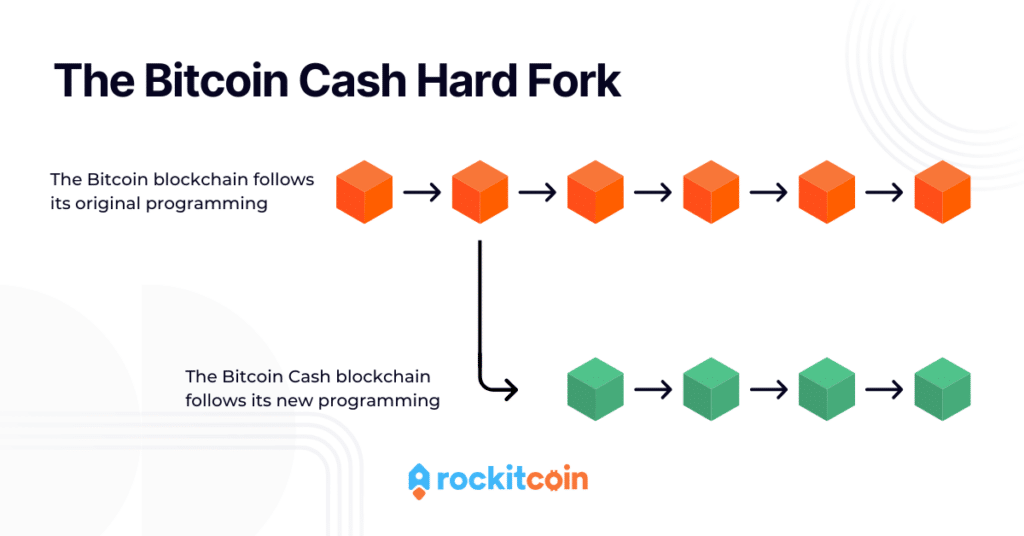
Bitcoin’s original blockchain faced significant challenges as its popularity grew. With a block size limit of 1 megabyte (MB), the network struggled to process the growing number of transactions. This congestion led to higher transaction fees and slower confirmation times, frustrating users.
To solve Bitcoin’s growing scalability issues, the community debated two major solutions:
- Segregated Witness (SegWit): This protocol reorganizes transaction data to fit more transactions into Bitcoin’s 1MB block size without increasing the block size limit. Supporters of SegWit argued that it enhanced capacity while keeping Bitcoin’s structure and security intact.
- Larger Block Size Limit: Another group of developers believed increasing the block size limit directly was the best solution. They argued this approach would allow Bitcoin to handle more transactions per block and reduce fees, making it more practical for everyday payments.
This disagreement revealed a deeper divide in priorities. The SegWit supporters emphasized security and decentralization, preferring minimal changes to Bitcoin’s architecture. In contrast, the group favoring larger block sizes prioritized usability and scalability for everyday transactions.
Ultimately, this conflict led to a hard fork on August 1, 2017, which created Bitcoin Cash as a separate blockchain. Bitcoin Cash launched with an 8MB block size, enabling it to process many more transactions per block compared to Bitcoin. Later, its block size limit was expanded to 32MB, further enhancing its ability to handle high transaction volumes efficiently.
Key Milestones in Bitcoin Cash’s Development
- August 2017: Bitcoin Cash officially launched as a separate blockchain.
- November 2018: Bitcoin Cash underwent another hard fork, splitting into Bitcoin Cash (BCH) and Bitcoin SV (BSV).
- Ongoing Improvements: Bitcoin Cash continues to adopt upgrades and features aimed at enhancing usability and scalability.
How Bitcoin Cash Works
Blockchain and Transactions
Bitcoin Cash operates on a decentralized blockchain, just like Bitcoin. However, its larger block size allows it to process an average of 116 transactions per second, compared to Bitcoin’s 7 transactions per second. This increased capacity reduces congestion and keeps transaction fees low, often under $0.01 per transaction.
Mining and Supply
Bitcoin Cash uses a proof-of-work (PoW) consensus mechanism, meaning miners validate transactions and secure the network by solving complex mathematical problems. The total supply of Bitcoin Cash is capped at 21 million coins, mirroring Bitcoin’s scarcity model. Over time, block rewards for miners decrease due to halving events, ensuring a gradual reduction in the rate of new BCH entering circulation.
Unique Features
- Larger Block Size: Facilitates faster transaction processing.
- CashAddr Format: A unique address format to differentiate Bitcoin Cash addresses from Bitcoin addresses, reducing the risk of errors.
- Token Creation: Bitcoin Cash supports creating tokens on its blockchain, expanding its use cases beyond simple transactions.
Bitcoin vs. Bitcoin Cash
Bitcoin Cash and Bitcoin share a common origin, but they differ significantly in their design philosophies and technical features. Here’s a detailed comparison:
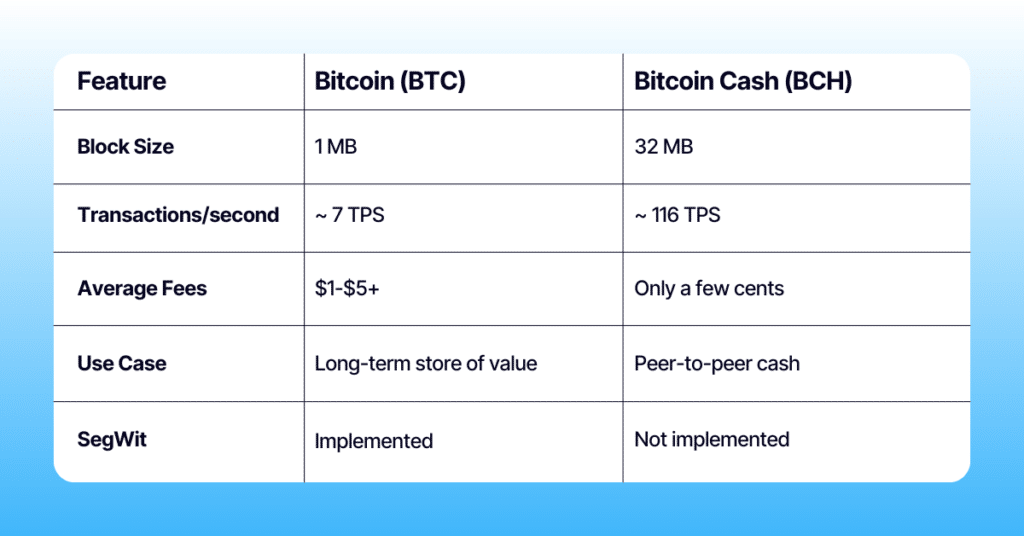
Philosophical Differences
- Bitcoin: Often referred to as “digital gold,” Bitcoin has become a store of value, prioritized for security and decentralization over transaction speed.
- Bitcoin Cash: Designed to function as a medium of exchange, focusing on fast, low-cost transactions for everyday use.
Compare Bitcoin vs Bitcoin Cash in more detail
Avoiding Confusion: Bitcoin vs. Bitcoin Cash Addresses
One of the dangers for new cryptocurrency users is confusing Bitcoin (BTC) and Bitcoin Cash (BCH). While these two cryptocurrencies share a common history, they have different address formats. Sending funds to the wrong type of address can result in irreversible loss.
Address Formats
- Bitcoin (BTC): Uses legacy and SegWit address formats.
- Bitcoin Cash (BCH): Introduced the CashAddr format, which is distinct from Bitcoin addresses to minimize errors.
How to Avoid Mistakes
- Double-check addresses: Ensure the address matches the cryptocurrency you’re using.
- Use Trusted Wallets: Choose wallets that clearly label BTC and BCH addresses.
- Leverage QR Codes: Scan QR codes to reduce manual input errors.
Why Bitcoin Cash Has Value
Bitcoin Cash derives its value from several key factors:
Low Transaction Fees
Bitcoin Cash’s larger block size reduces congestion, keeping transaction costs low. This makes it ideal for microtransactions and cross-border payments.
Fast Transactions
With confirmations taking seconds, Bitcoin Cash enables near-instant payments, whether you’re buying a coffee or transferring money internationally.
Decentralized Network
Like Bitcoin, Bitcoin Cash operates without a central authority, ensuring censorship-resistant transactions and financial sovereignty.
Limited Supply
With a maximum supply of 21 million coins, Bitcoin Cash maintains scarcity, supporting its long-term value.
Bitcoin Cash Price History
Since its launch in 2017, Bitcoin Cash’s price has experienced significant ups and downs, often reflecting the overall volatility of the cryptocurrency market. When Bitcoin Cash was first introduced, it traded at several hundred dollars per coin and quickly rose to an all-time high of over $4,000 in December 2017 during the cryptocurrency boom.
However, like many cryptocurrencies, Bitcoin Cash saw a sharp decline in 2018 as the market corrected. Its price has since stabilized at lower levels, though it has experienced periodic spikes driven by market trends, adoption announcements, and speculative trading.
How to Buy and Store Bitcoin Cash
How to Buy Bitcoin Cash
RockItCoin ATMs
RockItCoin ATMs are a fast and secure way to purchase Bitcoin Cash. Users can easily find a nearby ATM through the RockItCoin website or app, making the buying process convenient. The ATMs offer step-by-step instructions to ensure even beginners can complete their purchase easily.
RockItCoin App
The RockItCoin App allows you to buy Bitcoin Cash directly using your credit or debit card. The app is user-friendly, providing a smooth transaction experience while ensuring your financial details are secure. With its mobile functionality, you can buy Bitcoin Cash anytime and anywhere.
How to Store Bitcoin Cash
Hardware Wallets
Hardware wallets, such as Ledger and Trezor, offer offline storage for Bitcoin Cash, adding an extra layer of security. These devices protect your funds from online threats and are ideal for long-term storage.
RockItCoin Wallet
The RockItCoin Wallet is a user-friendly mobile wallet designed with robust security features. It provides an accessible way for beginners and experienced users to store Bitcoin Cash safely on their devices.
Software Wallets
Software wallets like Trust Wallet and Exodus support Bitcoin Cash and are convenient for daily transactions. These applications provide a balance between security and usability for managing your BCH holdings.
Use Cases for Bitcoin Cash
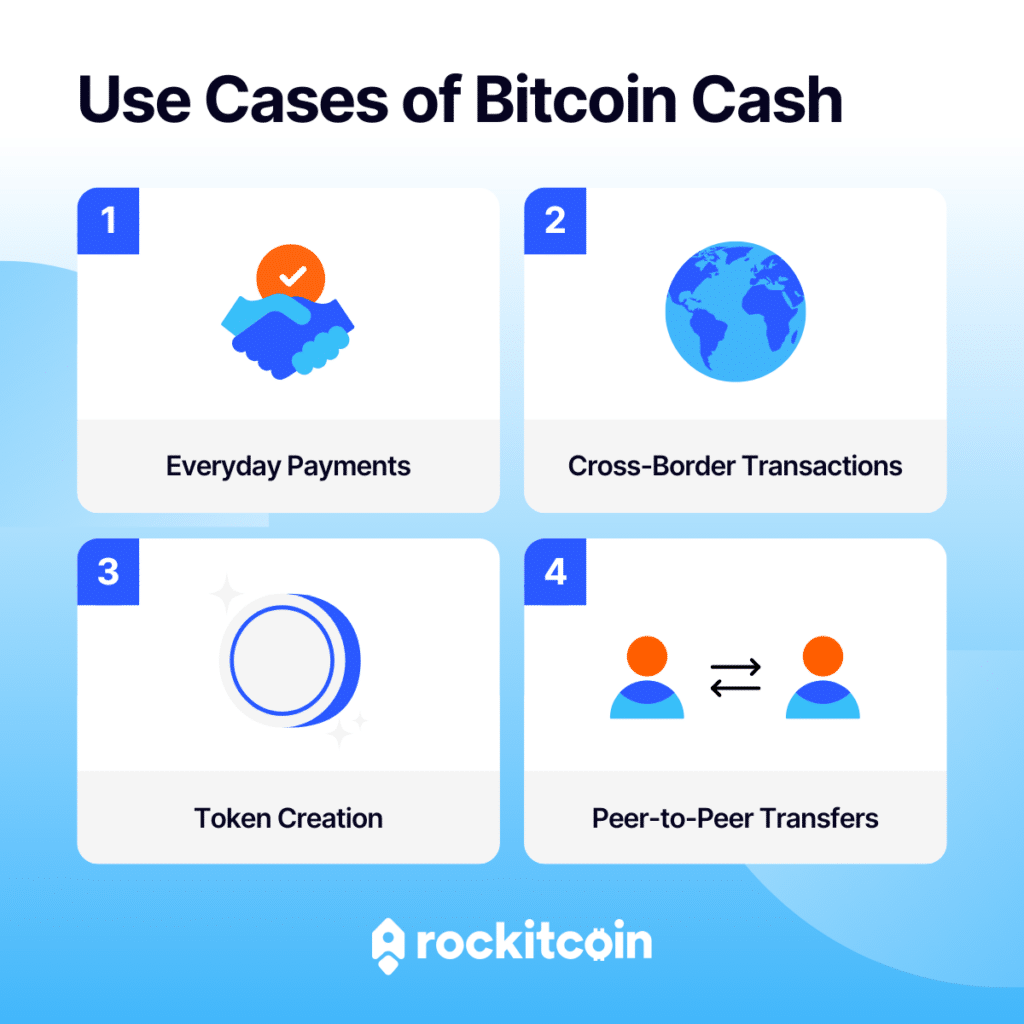
Bitcoin Cash is designed to be a practical, everyday cryptocurrency. Here are some of its primary use cases:
Everyday Payments
Bitcoin Cash is accepted by thousands of merchants worldwide, including travel companies, online retailers, and local businesses.
Cross-Border Transactions
Low fees and fast processing make BCH ideal for international remittances.
Smart Contracts and Token Creation
Developers can use the Bitcoin Cash blockchain to create tokens and decentralized applications for the DeFi ecosystem.
Peer-to-Peer Transfers
Send money to friends or family instantly without relying on banks or payment processors.
Challenges of Bitcoin Cash
Adoption Challenges
Despite its advantages, Bitcoin Cash lags behind Bitcoin in terms of merchant adoption and overall use.
Competition
Faster cryptocurrencies like Solana and Stellar offer stiff competition, boasting higher transaction speeds and lower fees.
Centralization Risks
A small number of mining pools dominate the Bitcoin Cash network, raising concerns about centralization.
Market Volatility
Like all cryptocurrencies, Bitcoin Cash is subject to price fluctuations, making it risky for speculative investors.
The Future of Bitcoin Cash
The future of Bitcoin Cash depends on several key factors, including its ability to grow adoption, remain competitive in a crowded market, and continue improving its technology. Developers and community members are actively working on upgrades to enhance its scalability, security, and usability.
One promising avenue for Bitcoin Cash is expanding its use in emerging markets where fast, low-cost transactions are highly valuable. Additionally, the continued integration of Bitcoin Cash into payment systems and e-commerce platforms could drive further adoption among businesses and consumers.
Conclusion
Bitcoin Cash was created to fulfill Bitcoin’s original vision of peer-to-peer electronic cash. By offering faster transactions and lower fees, it stands out as a practical alternative for everyday payments. However, users must be mindful of the risks, including confusion with Bitcoin and competition from other cryptocurrencies.
Ready to get started? Visit a RockItCoin ATM or download our app to buy Bitcoin Cash today!
Frequently Asked Questions (FAQs)
What is Bitcoin Cash?
Bitcoin Cash (BCH) is a cryptocurrency that was created as a result of a Bitcoin hard fork in 2017. It aims to provide faster transactions and lower fees than Bitcoin.
How does Bitcoin Cash differ from Bitcoin?
Bitcoin Cash focuses on being a fast, low-cost payment system, while Bitcoin is often seen as a store of value, similar to digital gold.
How can I buy Bitcoin Cash?
You can purchase Bitcoin Cash through RockItCoin ATMs, the RockItCoin app, or popular cryptocurrency exchanges like Coinbase, Kraken, and Binance.
Is Bitcoin Cash secure?
Yes, Bitcoin Cash is secure. It uses blockchain technology and a decentralized network of miners to validate transactions and protect the system.
Can I use Bitcoin Cash for online and in-person payments?
Absolutely. Bitcoin Cash is accepted by thousands of merchants worldwide, making it a practical option for both online and in-person purchases.
What are the transaction fees for Bitcoin Cash?
Transaction fees for Bitcoin Cash are typically less than $0.01, making it one of the most cost-effective cryptocurrencies for payments.
How is Bitcoin Cash stored?
Bitcoin Cash can be stored in secure wallets such as the RockItCoin app, hardware wallets like Ledger and Trezor, or software wallets like Exodus and Trust Wallet.
What risks are associated with Bitcoin Cash?
Bitcoin Cash faces risks such as lower adoption compared to Bitcoin, competition from faster cryptocurrencies, and centralization concerns in its mining pools.