

Cryptocurrencies like Bitcoin operate on a technology known as blockchain, and at the heart of this innovation lies a powerful mechanism called Proof of Work (PoW). If you’ve ever wondered how Bitcoin transactions are secured or how miners earn rewards, PoW is the answer. In this guide, we’ll break down everything you need to know about Proof of Work, how it works, its benefits, and its challenges.
Key Takeaways
- Proof of Work (PoW) is a consensus mechanism that secures blockchain networks by requiring miners to solve complex mathematical puzzles.
- PoW offers proven security and decentralization but is energy-intensive and has scalability challenges.
- Despite alternatives like Proof of Stake (PoS), PoW remains a cornerstone of blockchain technology due to its reliability and resilience.
What is Proof of Work?
Proof of Work (PoW) is a consensus mechanism that secures blockchain networks. It ensures that all transactions are verified and blocks are added to the blockchain without relying on a central authority, like a bank. PoW achieves this by requiring network participants, known as miners, to solve complex mathematical puzzles, demonstrating that they have invested computational effort into maintaining the network.
The idea behind PoW predates Bitcoin. It was first conceptualized in the 1990s as a way to prevent spam emails. Later, Hal Finney introduced the concept of “reusable Proof of Work” in 2004, which laid the groundwork for Bitcoin’s implementation of PoW. Satoshi Nakamoto, Bitcoin’s pseudonymous creator, adopted PoW as the foundation for Bitcoin’s blockchain in 2009, making it the first successful application of this mechanism in cryptocurrency.
The History and Evolution of Proof of Work
Proof of Work wasn’t originally created for cryptocurrencies. Its first use came in the 1990s when it was designed to fight spam emails. The idea was simple: make it costly for someone to send bulk emails by requiring them to solve a small computational problem first.
In 1997, computer scientist Adam Back built on this idea with a system called Hashcash, which used computational puzzles to limit email spam and denial-of-service attacks. A few years later, Hal Finney adapted this concept into “reusable Proof of Work,” which laid the foundation for cryptocurrency applications.
Satoshi Nakamoto, the mysterious creator of Bitcoin, took these ideas and used them to create a decentralized network in 2009. By requiring miners to solve these computational puzzles, Bitcoin became the first digital currency to securely process transactions without a central authority. The first Bitcoin transaction took place on January 12th, 2009, and the network has been running securely ever since.
How Does Proof of Work Work?
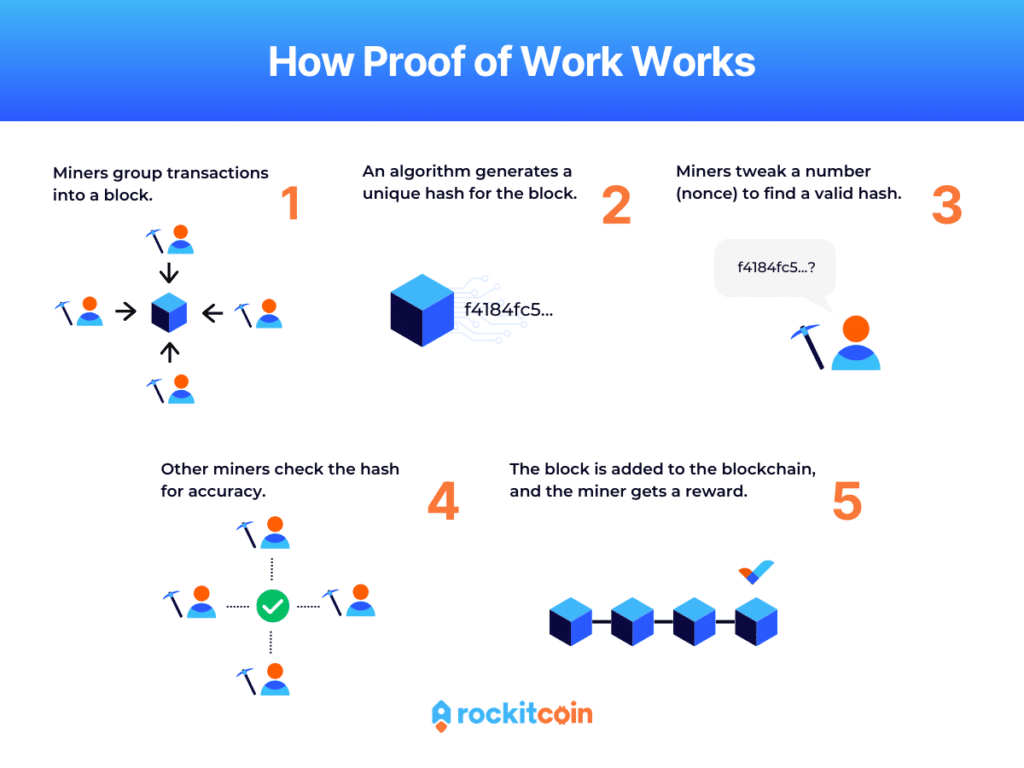
To understand PoW, let’s break it down step by step:
- Transaction Collection: Miners gather pending transactions and group them into a block.
- Hashing the Block: A cryptographic algorithm, such as Bitcoin’s SHA-256, is applied to the block’s data. This produces a unique string of characters called a hash.
- Nonce Adjustment: Miners must find a hash that meets specific requirements set by the blockchain. To achieve this, they adjust a variable called a “nonce” (a number that is only used once) repeatedly until the hash meets the target difficulty.
- Verification: When a miner discovers a valid hash, they share the block with the network. Other miners verify that the hash and block comply with the rules.
- Blockchain Addition: If the block is valid, it is added to the blockchain. The miner who found the valid hash earns a reward, which includes newly created cryptocurrency and transaction fees.
This system ensures the network stays secure and decentralized. The difficulty of finding a valid hash is periodically adjusted to keep block creation times consistent, typically every 10 minutes for Bitcoin.
The Role of Miners in the Blockchain Ecosystem
Miners are the backbone of Proof of Work systems. Their job goes beyond solving puzzles—they play a critical role in keeping the blockchain secure and operational. Here’s what they do:
- Validate Transactions: Miners ensure that all transactions added to the blockchain are legitimate. They check for issues like double spending (where someone tries to spend the same cryptocurrency twice).
- Secure the Network: By competing to solve puzzles, miners make it extremely hard for anyone to tamper with past transactions. This ensures the blockchain remains trustworthy.
- Earn Rewards: Miners are incentivized with rewards, which include newly created cryptocurrency and transaction fees. This motivates them to keep the network running smoothly.
Mining is highly competitive. Only the first miner to solve a puzzle gets the reward, which drives innovation in mining hardware and techniques. However, this competition also leads to increased energy consumption.
Why is Proof of Work Important?
Proof of Work serves several crucial functions in blockchain networks:
- Security: PoW makes it computationally expensive for bad actors to alter transaction data or attempt a “double-spend” attack.
- Decentralization: It eliminates the need for a central authority, allowing anyone with sufficient computing power to participate.
- Incentivization: Miners are rewarded for their efforts, encouraging them to maintain and secure the network.
These benefits have made PoW the gold standard for securing decentralized networks like Bitcoin.
Examples of Proof of Work Cryptocurrencies
While Bitcoin is the most well-known cryptocurrency to use PoW, it’s not the only one. Here are a few notable examples:
- Bitcoin (BTC): The first and most popular cryptocurrency. Its PoW mechanism uses the SHA-256 algorithm.
- Litecoin (LTC): A Bitcoin alternative with faster transaction times, using the Scrypt algorithm.
Read the comparison of Litecoin vs Bitcoin
- Dogecoin (DOGE): Initially created as a joke, Dogecoin has gained a loyal following and also uses Scrypt.
- Monero (XMR): Focused on privacy and decentralization, Monero’s PoW mechanism is designed to be resistant to specialized mining hardware.
Ethereum’s Transition from PoW to PoS
Ethereum, the second-largest cryptocurrency by market cap, originally used Proof of Work. However, its developers recognized the environmental and scalability challenges of PoW. In September 2022, Ethereum completed its transition to Proof of Stake (PoS) in an upgrade called “The Merge.”
Under PoS, Ethereum no longer relies on miners to validate transactions. Instead, validators—participants who “stake” their cryptocurrency—are selected to confirm transactions and create new blocks. This shift drastically reduced Ethereum’s energy consumption by over 99%.
While PoS offers significant advantages in terms of energy efficiency and transaction speed, it has its critics. Some argue that PoS could lead to centralization, as participants with larger stakes have more influence over the network. Despite this, Ethereum’s move has been widely seen as a step forward in making blockchain technology more sustainable.
Advantages of Proof of Work
Proof of Work offers several advantages that have contributed to its widespread adoption:
- Proven Security: PoW has been tested and proven reliable over more than a decade, particularly in securing Bitcoin’s network.
- Resistance to Centralization: By requiring computational effort, PoW makes it difficult for any single entity to control the network.
- Immutable Transactions: Once a block is added to the blockchain, it becomes nearly impossible to alter, ensuring data integrity.
Limitations of Proof of Work
Despite its strengths, PoW is not without its challenges:
- Centralization Risks: Large mining operations control over 50% of the Bitcoin hash rate, with Foundry USA leading at approximately 34% as of late 2024.
- Scalability Issues: PoW-based networks often have slower transaction speeds and higher fees compared to alternatives like Proof of Stake (PoS).
Environmental Impact and Green Solutions
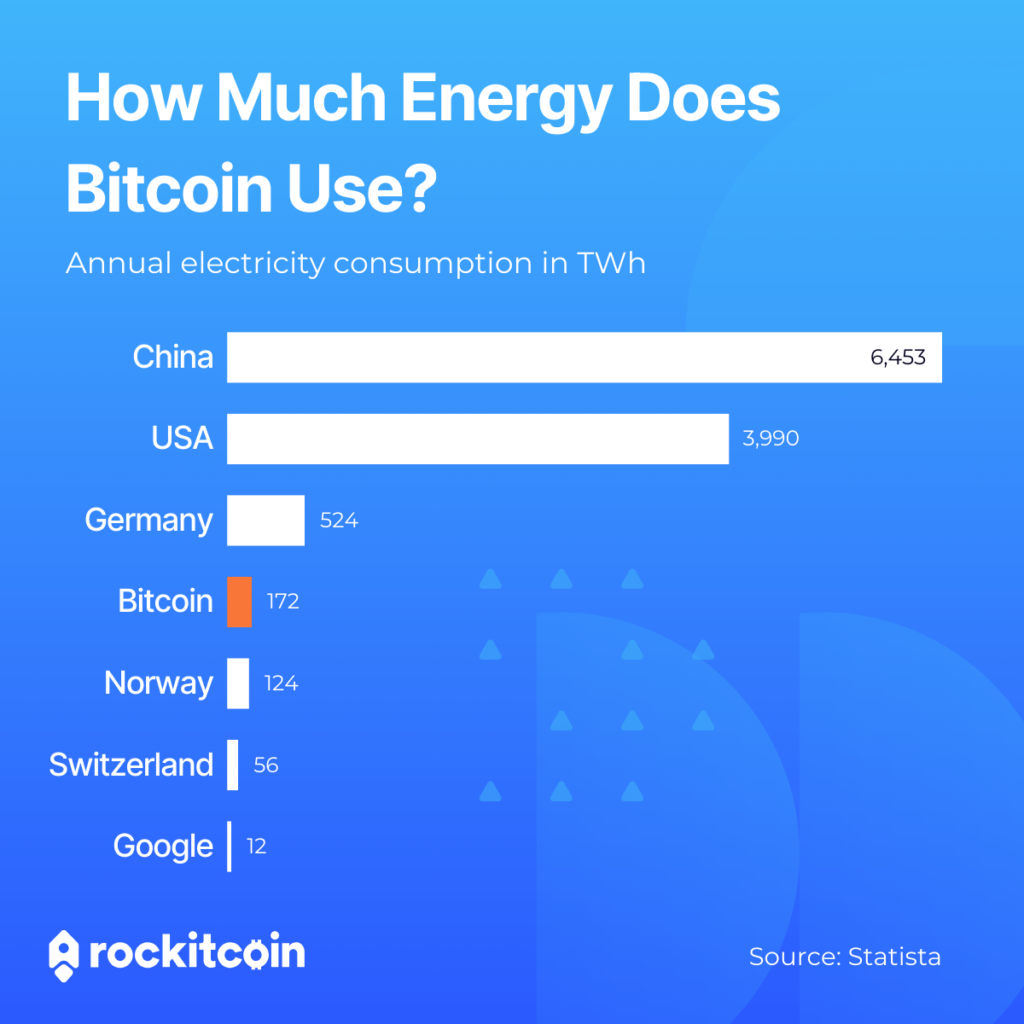
Proof of Work has drawn criticism for its energy usage. The computational puzzles miners solve require powerful hardware, which consumes significant electricity. For instance, Bitcoin mining alone in 2025 is projected to use approximately 172 terawatt-hours (TWh) of electricity, more than the entire annual electricity consumption of countries like Norway.
This has raised environmental concerns, especially as much of this energy comes from non-renewable sources. However, there are ongoing efforts to reduce PoW’s environmental impact:
- Renewable Energy Mining: Over 50% of Bitcoin mining in 2024 is powered by renewable energy. Some miners are turning to wind, solar, and hydropower to run their operations sustainably.
- Improved Hardware: Newer mining equipment, like ASICs, is designed to be more energy-efficient, reducing the electricity needed per computation.
- Relocating Operations: Miners are moving to regions with surplus energy, such as Iceland, which uses geothermal energy, to lower their carbon footprint.
These steps are helping make mining more sustainable while keeping the network secure.
Proof of Work vs. Proof of Stake
Proof of Stake (PoS) is the main alternative to PoW. Instead of requiring computational effort, PoS validators “stake” their cryptocurrency as collateral to validate transactions and create new blocks. Here’s how the two compare:
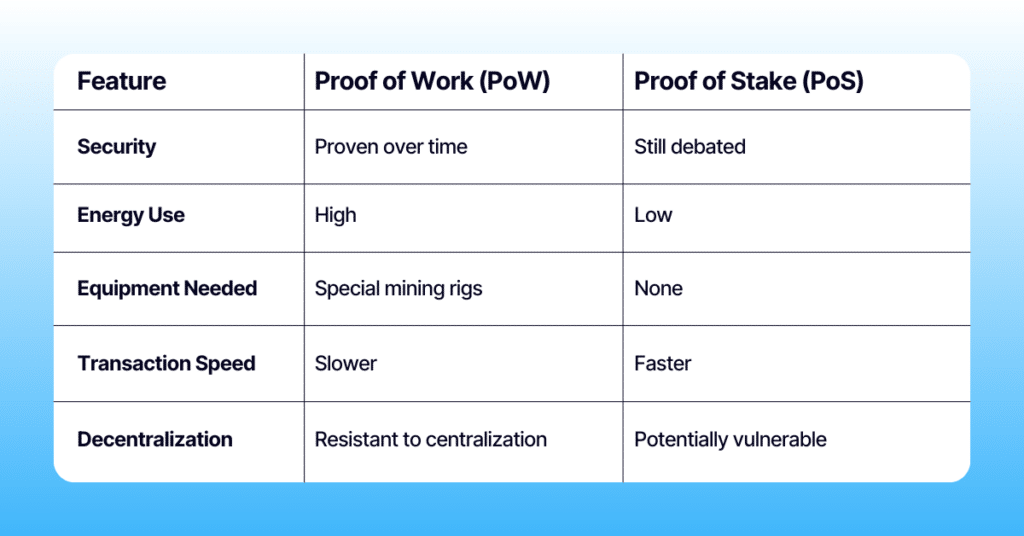
While PoS is more energy-efficient, PoW remains the most trusted mechanism for ensuring blockchain security.
Learn more about the differences between Proof of Work vs Proof of Stake
The Future of Proof of Work
As concerns about energy consumption grow, efforts are underway to make PoW more sustainable. Innovations such as renewable energy-powered mining and improved mining hardware are reducing the environmental impact of PoW networks. Additionally, PoW’s proven track record ensures it will remain a cornerstone of blockchain technology for the foreseeable future.
Conclusion
Proof of Work has revolutionized how transactions are verified and secured in decentralized systems. While it faces criticism for its energy consumption, its security and resilience have made it a foundational element of blockchain technology. As the crypto industry evolves, PoW’s role may adapt, but its significance in the history of cryptocurrency is undeniable.
Interested in exploring PoW cryptocurrencies like Bitcoin and Litecoin? Visit a RockItCoin Bitcoin ATM today to start your journey.
Frequently Asked Questions (FAQs)
What is the purpose of Proof of Work?
Proof of Work ensures the security and integrity of blockchain networks by requiring computational effort to validate transactions and create new blocks.
Why is Proof of Work energy-intensive?
The computational puzzles miners solve require significant power, ensuring that bad actors cannot easily manipulate the network.
Which cryptocurrencies use Proof of Work?
Bitcoin, Litecoin, Dogecoin, Monero, and Bitcoin Cash are notable examples of PoW-based cryptocurrencies.
How does Proof of Work compare to Proof of Stake?
PoW is more energy-intensive but offers proven security. PoS is faster and more energy-efficient but faces centralization concerns.